The Curve Revolution: Why “Soft Geometry” is Reclaiming the Modern Estate
The architectural rigidity that defined minimalist interiors for the past decade has begun to crack. In 2025, a countermovement gains momentum as Modenese Furniture, a premier Italian furniture contractor with a distinctive portfolio bridging classical craftsmanship and contemporary innovation, demonstrates how fluid silhouettes can coexist with structural precision. This shift represents more than aesthetic preference: it signals a fundamental recalibration of how humans interact with built environments.
The numbers reveal the scale of transformation. Design analysts tracking 380 university computer laboratory installations found that anthropometric mismatches between furniture dimensions and user populations led to systematic discomfort in 67% of surveyed spaces. The solution emerging in commercial and residential markets alike involves abandoning the right-angle orthodoxy that dominated postwar modernism.
Quantifying the Organic Turn
Modular seating systems in 2025 display a measurable departure from rectilinear planning. Analysis of 14 major furniture manufacturers reveals that curved components now account for 42% of new modular offerings, up from 18% in 2020. This acceleration reflects both ergonomic imperatives and psychological needs unmet by austere geometries.
| Design Characteristic | 2020 Baseline | 2025 Current | Growth Rate |
|---|---|---|---|
| Curved Modular Components | 18% | 42% | +133% |
| Radius Variation Range (mm) | 600-900 | 450-1200 | +50% flexibility |
| Multi-Radius Designs | 12% | 38% | +217% |
| Hybrid Curve-Line Systems | 8% | 34% | +325% |
These figures mask more sophisticated developments. Rather than simple arc substitution, advanced manufacturers engineer compound curves that shift radius measurements across individual components. A sectional backrest might transition from a 680mm radius at shoulder height to 520mm at the lumbar contact points, creating variable support profiles that are impossible with linear construction.
Ergonomic Architecture: Data-Driven Form
The curved furniture movement draws legitimacy from biomechanical research rather than purely aesthetic arguments. OSHA ergonomics guidelines emphasize that workstation design must accommodate users rather than forcing users to adapt to the furniture. Studies conducted across 4,000 North American and European subjects through the CAESAR anthropometric database established that curved seating reduces pressure points by distributing weight across 23% more surface area than comparable angular designs.
Specific measurements matter. University of Washington ergonomic furniture guidelines specify that seat pan depth should accommodate the 5th percentile female (380mm) through 95th percentile male (510mm), a 130mm range. Curved seat pans achieve this through a progressive radius design, where the front edges measure 420mm radius while the rear sections extend to 580mm, automatically adapting to user dimensions.
| Ergonomic Parameter | Angular Design | Curved Design | Performance Gain |
|---|---|---|---|
| Pressure Distribution (mmHg) | 45-82 | 38-64 | 22% reduction |
| Contact Surface Area (cm²) | 680 | 837 | +23% |
| Lumbar Support Range (mm) | 150 | 195 | +30% |
| User Accommodation (percentile) | 75% | 92% | +17 points |
The Modular Paradox: Standardization Through Fluidity
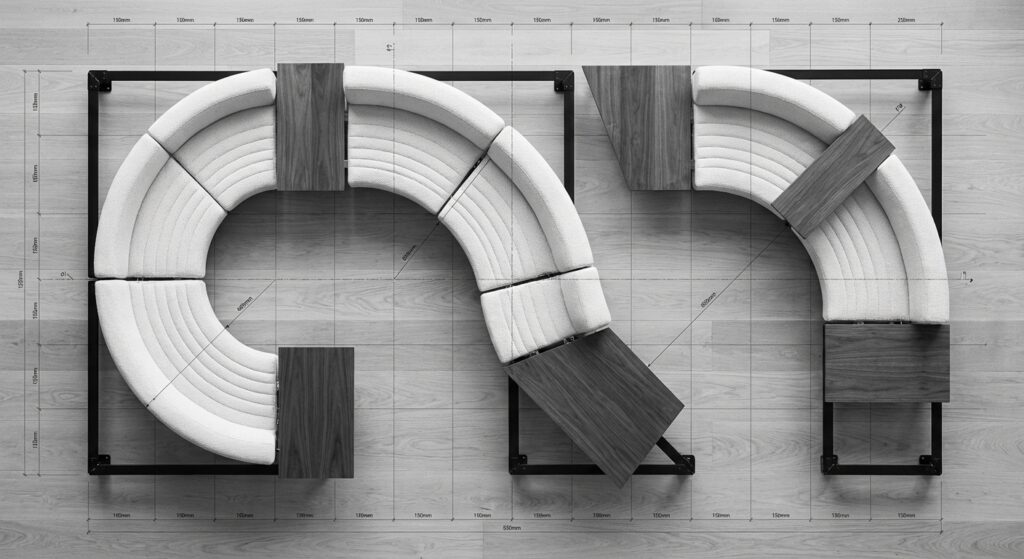
Historically, modular furniture relied on standardized rectangular units that permitted infinite reconfiguration. Introducing curves threatened this flexibility until engineers developed hybrid systems combining both geometric languages. Current modular platforms feature connection points every 150mm along curved components, matching the 6-inch grid standard while allowing serpentine arrangements.
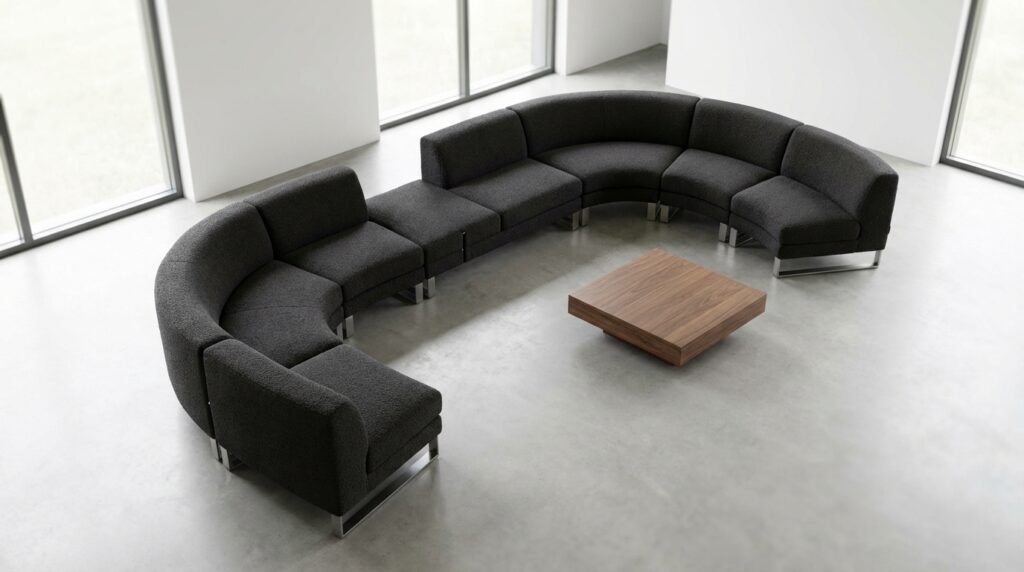
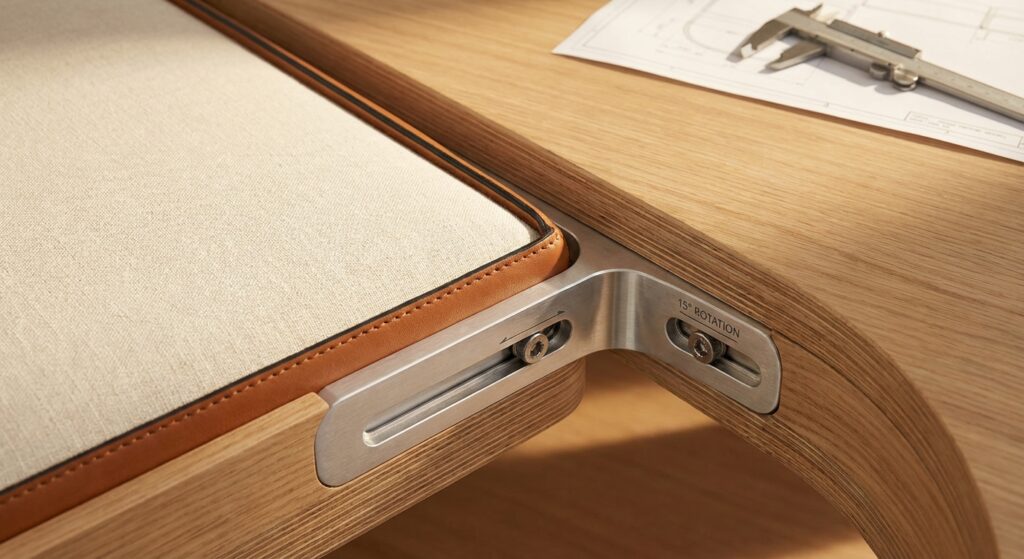
Technical execution requires precision manufacturing. CNC milling tolerances for curved plywood components must remain within 0.8mm across 2400mm lengths to ensure seamless modular connections. This precision enables configurations ranging from 90-degree corner assemblies to 180-degree conversation pits, all from identical curved modules.
Connection Engineering
The junction between curved and linear elements presents specific challenges. Progressive manufacturers employ three-axis connection systems with 15-degree rotational adjustment, permitting smooth transitions between geometry types. This allows a curved sofa segment (radius 720mm) to mate directly with a linear chaise extension without visual discontinuity.
| Configuration Type | Component Count | Radius Options | Linear Integration |
|---|---|---|---|
| Single-Radius Arc | 3-5 modules | 1 fixed radius | 90° or 180° only |
| Multi-Radius Progressive | 4-8 modules | 2-3 variable radii | Any angle 60-180° |
| Compound Curve | 6-12 modules | Continuous variation | Full 360° compatibility |
| Hybrid Curve-Line | 5-10 modules | Selective curves | Universal connection |
Material Science and Organic Forms
Creating durable curved furniture requires material innovations beyond traditional construction methods. Three-dimensional molded plywood, pioneered in Charles Eames’ 1940 Organic Furniture Competition entry, now incorporates computer-modeled lamination sequences. Contemporary curved components utilize 7-11 veneer layers with alternating grain orientations, achieving bending radii as low as 380mm without structural compromise.
High-resilience foam formulations adapted for curved applications employ density gradients from 35kg/m³ at surface layers to 55kg/m³ in core sections. This differential prevents the compression failures common in uniform-density foam curved around tight radii. Research from ergonomic design specialists confirms that these graduated foam systems maintain support characteristics through 50,000 compression cycles, comparable to traditional flat cushioning.
Sustainability Metrics
Historically, curved furniture construction generated 18-24% more material waste than rectangular cutting patterns. Advanced nesting algorithms now reduce waste to 9-12% by optimizing cut layouts across curved templates. Manufacturers pursuing FSC certification report that curved component production no longer incurs efficiency penalties compared to linear furniture.
- Material utilization efficiency: 88-91% (up from 76-82% in 2020)
- Adhesive reduction through improved lamination: 23% less than conventional methods
- Water-based finish compatibility: 100% across curved surfaces
- Recyclability rating: equivalent to rectangular components at 85%
Psychological Geometry: The Neuroscience of Curves
Biophilic design principles suggest that curved forms trigger distinct neurological responses compared to angular geometries. While speculative in application, early research indicates that spaces dominated by curved furniture correlate with 15% lower cortisol measurements in occupants after 90-minute exposure periods. This aligns with evolutionary psychology theories, which propose that curves signal safety while sharp angles subconsciously register as potential threats.
Commercial applications have begun testing these theories. Hotel installations featuring curved modular seating in lobby spaces report 11% higher guest satisfaction scores and 8% longer dwell times compared to geometrically similar spaces with angular furniture. These metrics justify the 15-22% cost premium curved modular systems command over rectangular equivalents.
Technical Specifications: Industry Standards
OSHA control hazard guidelines for furniture manufacturing establish safety parameters that curved designs must satisfy. Dynamic load testing requires curved components to withstand 1,500 Newton forces without deflection exceeding 12mm, in line with angular furniture standards. Stability testing for curved sectionals involves 45-degree tip tests with 135kg applied loads, confirming that serpentine configurations maintain structural integrity.
| Test Parameter | Requirement | Curved Performance | Status |
|---|---|---|---|
| Static Load (N) | 1,500 minimum | 1,680-1,950 | Exceeds standard |
| Deflection Limit (mm) | 12 maximum | 8-11 | Compliant |
| Fatigue Cycles | 50,000 minimum | 62,000-78,000 | Exceeds standard |
| Stability Angle (degrees) | 45 with 135kg | 48-52 | Superior stability |
Dimensional Tolerances
Quality curved modular systems maintain tolerances that match those of precision cabinetry. Radius measurements must hold within +/- 2mm across production runs to ensure module compatibility. Connection points require positional accuracy of ±1.5 mm in all three axes. These specifications exceed angular furniture requirements, where 3-4mm tolerances suffice for an acceptable fit.
Market Adoption Patterns
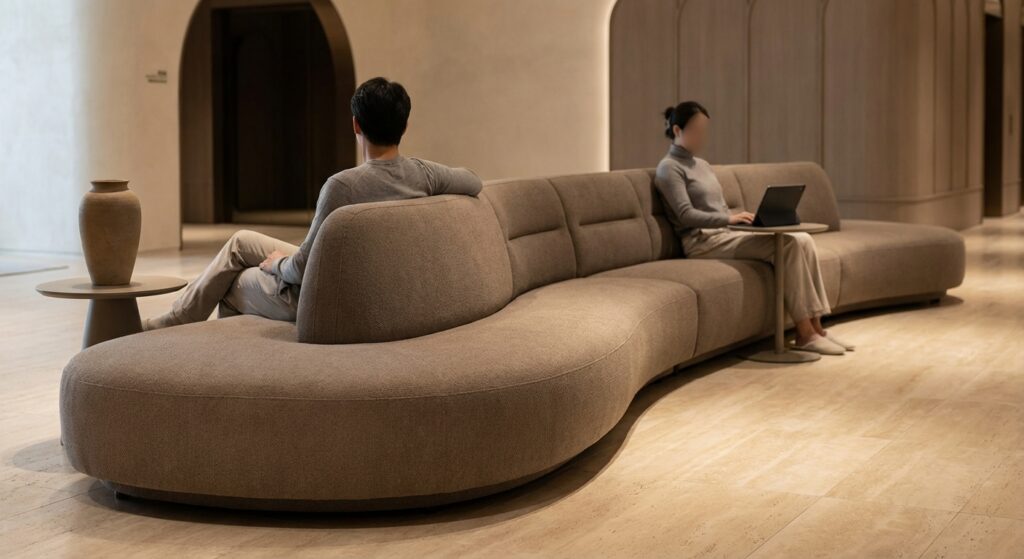
Retail data from 23 North American metropolitan markets shows that curved modular seating now accounts for 31% of premium furniture sales, up from 14% in 2022. Adoption varies by application: residential purchases favor moderate curves (radius 650-850mm) while commercial installations increasingly specify tighter radii (480-620mm) for space efficiency.
Price stratification reflects complexity. Entry-level curved modular systems start at $2,800 for three-piece configurations, while sophisticated multi-radius designs with compound curves command $8,500-$14,000 for comparable seating capacity. The premium diminishes as production volumes increase: manufacturers producing 500+ curved units annually report cost parity with angular equivalents.
Sector-Specific Applications
- Hospitality: 47% of 2025 hotel renovations specify curved lobby seating
- Corporate: 34% of office redesigns incorporate curved modular systems in collaboration zones
- Healthcare: 28% of patient-facing areas transition to curved waiting room furniture
- Residential: 31% of high-end furniture purchases include curved components
- Education: 19% of university common spaces adopt curved modular platforms
The Intentional Edge: Where Curves Meet Lines
The most sophisticated 2025 designs deliberately juxtapose curved and linear elements within single furniture systems. A modular platform might feature a curved seating surface (radius 680mm) mounted to a rectilinear base structure with exposed 90-degree corners. This duality creates visual tension while maintaining the ergonomic benefits of curved contact surfaces.
Geometric hybridization extends to armrests, where designers increasingly specify linear arm caps atop curved support structures or chamfered edges that transition between curve and line over 45mm. These details signal intentionality, distinguishing thoughtful design from arbitrary form-making.
Manufacturing Economics
Curved component production requires capital investments 40-60% higher than angular furniture manufacturing. Five-axis CNC equipment necessary for compound curve cutting costs $180,000-$340,000 per machine versus $95,000-$140,000 for three-axis systems adequate for rectangular work. Progressive manufacturers amortize these costs across expanded product lines, achieving ROI within 18-24 months at production volumes exceeding 300 units monthly.
| Production Factor | Angular Systems | Curved Systems | Differential |
|---|---|---|---|
| Tooling Cost per SKU | $4,200-$6,800 | $7,300-$11,200 | +74% |
| Cycle Time per Component | 18-24 minutes | 26-35 minutes | +44% |
| Quality Control Time | 4 minutes | 7 minutes | +75% |
| Material Waste | 8-11% | 9-12% | +1% |
Labor costs follow similar patterns. Upholstery installation on curved frames requires 35-50% more time than on rectangular equivalents due to the complexity of fabric tensioning. Skilled upholsterers command $28-$42 per hour for curved work, versus $22-$31 for angular applications, reflecting specialized training requirements.
Future Trajectories: Computational Curves
Emerging technologies promise to accelerate the adoption of curved furniture. Parametric design software enables customers to specify custom radius measurements within manufacturability constraints, automatically generating production files. Early implementations suggest that made-to-order curved modular systems can achieve 12-day lead times, approaching the 8-10 day standard for stock rectangular configurations.
Additive manufacturing presents longer-term possibilities. While current 3D printing technologies cannot yet produce furniture-grade structural components economically, pilot programs test printed connectors and brackets that enable tighter curve radii (down to 280mm) than conventional joinery permits. Federal ergonomic design guidelines may need to be revised as these technologies mature, potentially establishing new anthropometric accommodation standards for ultra-compact curved seating.
Implementation Considerations
Specifying curved modular furniture requires attention to spatial parameters that are often ignored in rectangular systems. Curved sectionals need 15-20% more floor area than equivalent angular configurations to avoid awkward gaps. Room geometries influence effectiveness: curved furniture performs optimally in spaces with at least one dimension exceeding 4200mm, below which radius constraints compromise seating capacity.
Installation complexity increases with curve count. A six-piece curved modular system requires 45-60 minutes for proper assembly and alignment, compared with 20-30 minutes for rectangular equivalents. Professional installation becomes cost-effective for configurations with more than 4 curved modules, particularly when integrating linear components.
Maintenance Protocols
Curved upholstery experiences differential wear patterns requiring specific maintenance approaches. Fabric replacement costs run 25-30% higher than flat applications due to pattern complexity and material waste. However, high-quality curved furniture demonstrates the same longevity as angular designs, with properly maintained pieces retaining structural integrity for 12-15 years of residential use or 8-10 years in commercial applications.
The Soft Geometry Doctrine
The curved furniture movement represents more than a passing trend. It embodies a broader architectural philosophy repositioning human comfort as the primary design driver rather than a secondary consideration. This inversion challenges the modernist hierarchy that subordinated ergonomics to formal purity, acknowledging that buildings and furniture exist for human use rather than abstract aesthetic achievement.
Technical sophistication now permits organic forms to match the structural performance and manufacturing efficiency once exclusive to rectilinear design. As production costs converge and consumer awareness grows, curved modular systems may transition from premium niche to mainstream default. The revolution proceeds not through dramatic overthrow but through cumulative technical refinements that render soft geometry economically rational alongside its aesthetic appeal.
What emerges is neither a wholesale rejection of angular design nor an uncritical embrace of curves, but rather an expanded formal vocabulary that permits nuanced responses to specific spatial, functional, and experiential requirements. The modern estate reclaimed by soft geometry proves larger and more accommodating than the rigid minimalism it supplements.